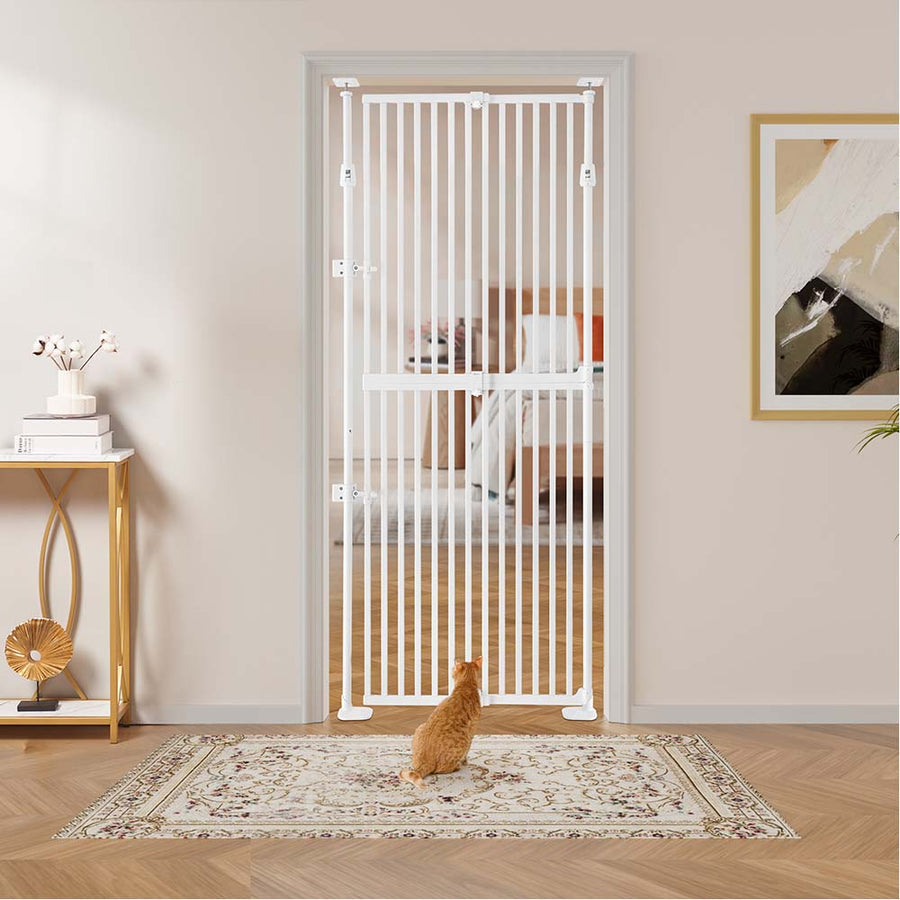






A dog gate creates a safe, defined boundary between your dog and areas of your home that are off-limits, hazardous, or simply need to stay pet-free.
Whether you need an indoor dog gate for a doorway, a pet safety gate for the top of the stairs, a dog barrier for an open-plan living area, or a stylish wooden dog gate that suits your home's interior, the right gate makes daily life safer and easier for both you and your dog. Modern Pets stocks a range of dog gates, pet gates, and puppy gates for homes of all layouts, with free metro shipping on orders over $99.
Why Use a Dog Gate?
Dog gates serve several distinct purposes, and understanding which applies to your household helps narrow down the right style and specification.
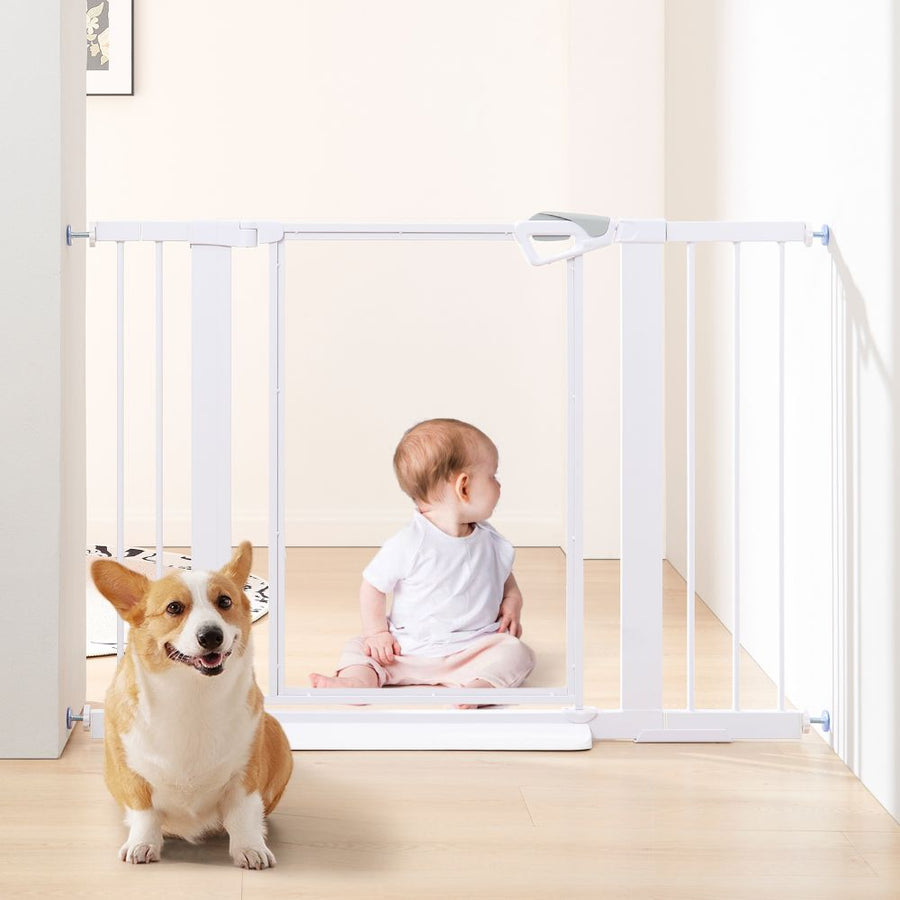
A pressure-mounted pet gate uses adjustable rubber feet or tension pads to wedge securely between two walls or door frames, no screws or wall fixings required. This makes them quick to install, easy to reposition between rooms, and removes the need for any wall damage.
Pressure-mounted indoor dog gates are the most popular choice for:
Important safety note: Pressure-mounted gates must never be used at the top of a staircase. If a dog pushes against a pressure-mounted gate at the top of stairs, the gate can dislodge under force and the dog can fall. At the top of stairs, a wall-mounted gate with fixed hardware is the only safe option.
A wall-mounted dog safety gate is fixed to the wall using screws and brackets, providing a significantly more secure barrier than a pressure-mounted equivalent. Wall-mounted gates are the correct choice for:
Wall-mounted installation requires drilling into walls and is not suitable for renters without permission. Most wall-mounted gates include fixings and installation instructions; check whether the fixings suit your wall type (plasterboard vs. masonry) before purchasing.
A retractable indoor pet gate uses a mesh or fabric panel that rolls out from a fixed wall-mounted housing and latches to a receiver on the opposite side. When not in use, the panel retracts neatly into the housing, leaving the opening clear.
Retractable gates suit households that value a low-visual-profile when the gate is open, and they work well for irregular openings that are difficult to fit with a standard rigid gate. They are available in wall-mounted formats and are suitable for stair use when correctly installed with fixed wall brackets.
Retractable gates are generally not suited to dogs that chew or scratch at barriers. The mesh panel is less resistant to persistent damage than a rigid metal or wooden gate.
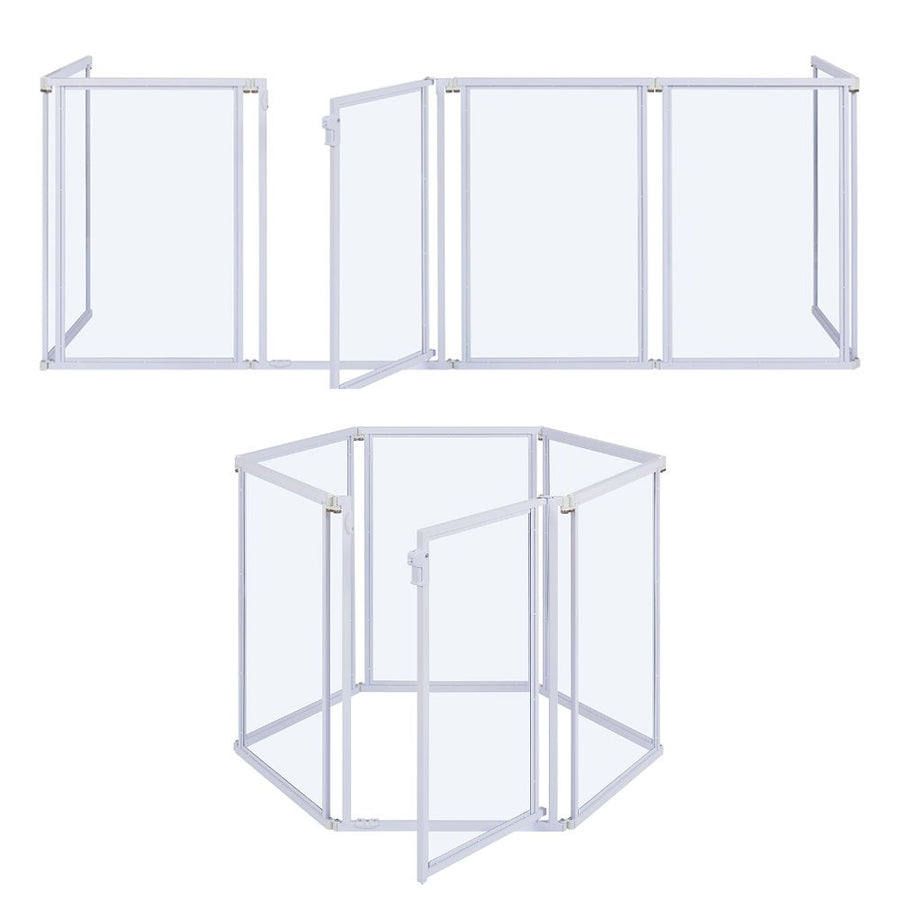
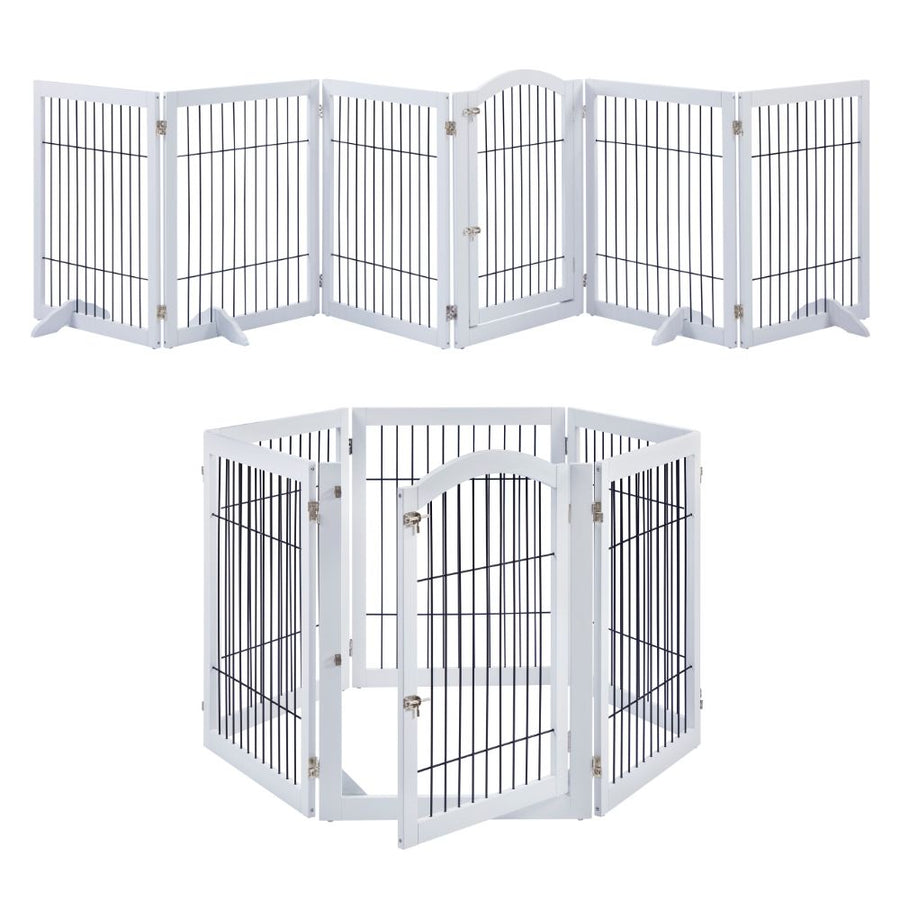
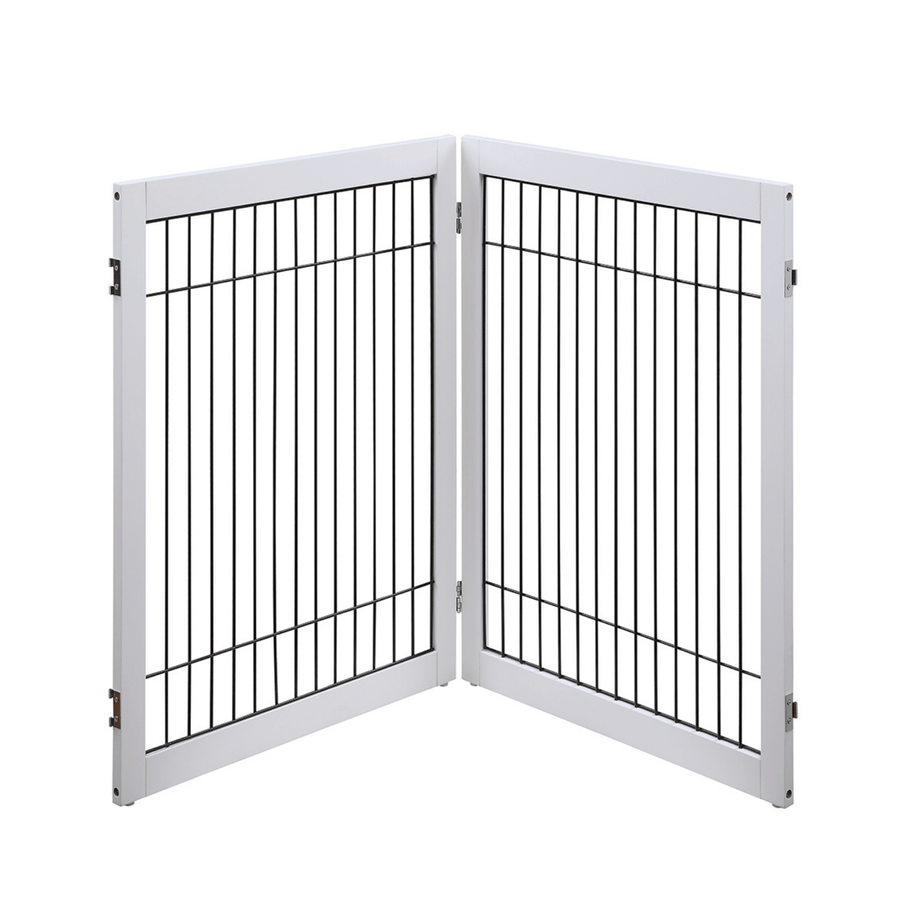
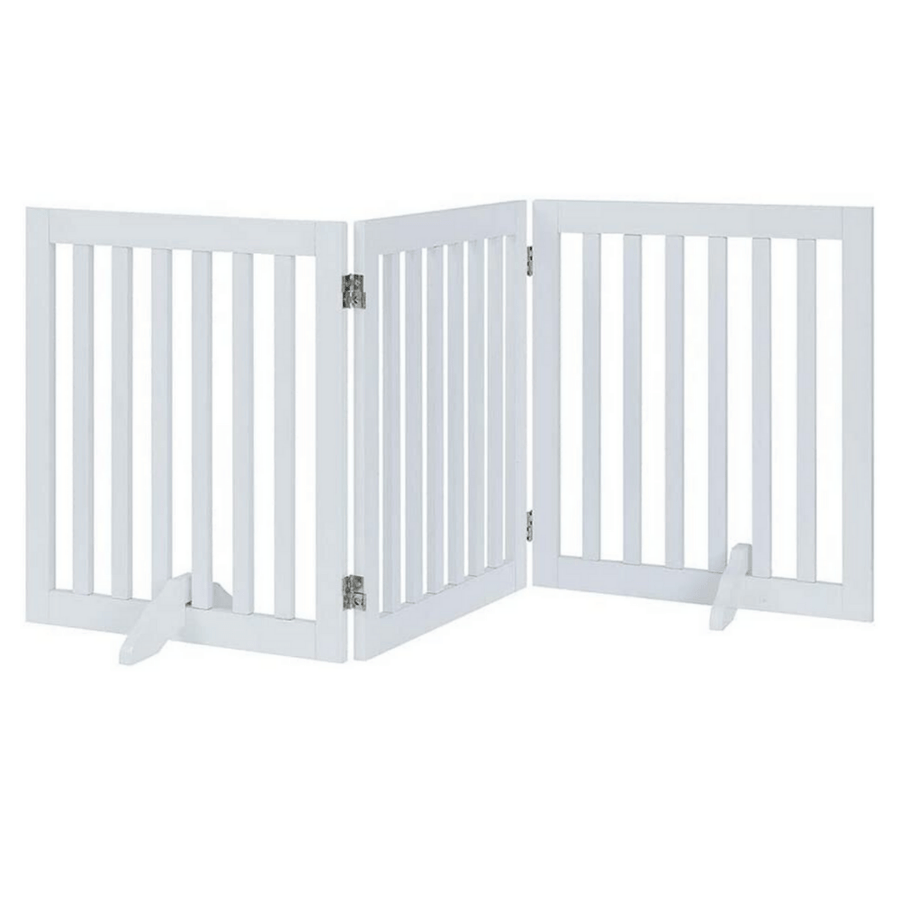
A freestanding pet barrier or configurable dog barrier fence consists of multiple panels connected by hinges that can be arranged into a straight barrier, an L-shape, or a fully enclosed pen. These do not attach to walls at all; they are self-supporting structures.
Freestanding dog barriers are useful for:
The limitation of freestanding pet barriers is that a determined or large dog can push them over. For persistent dogs, weighting the base or securing the ends to furniture adds stability. Also check out our dog playpens.
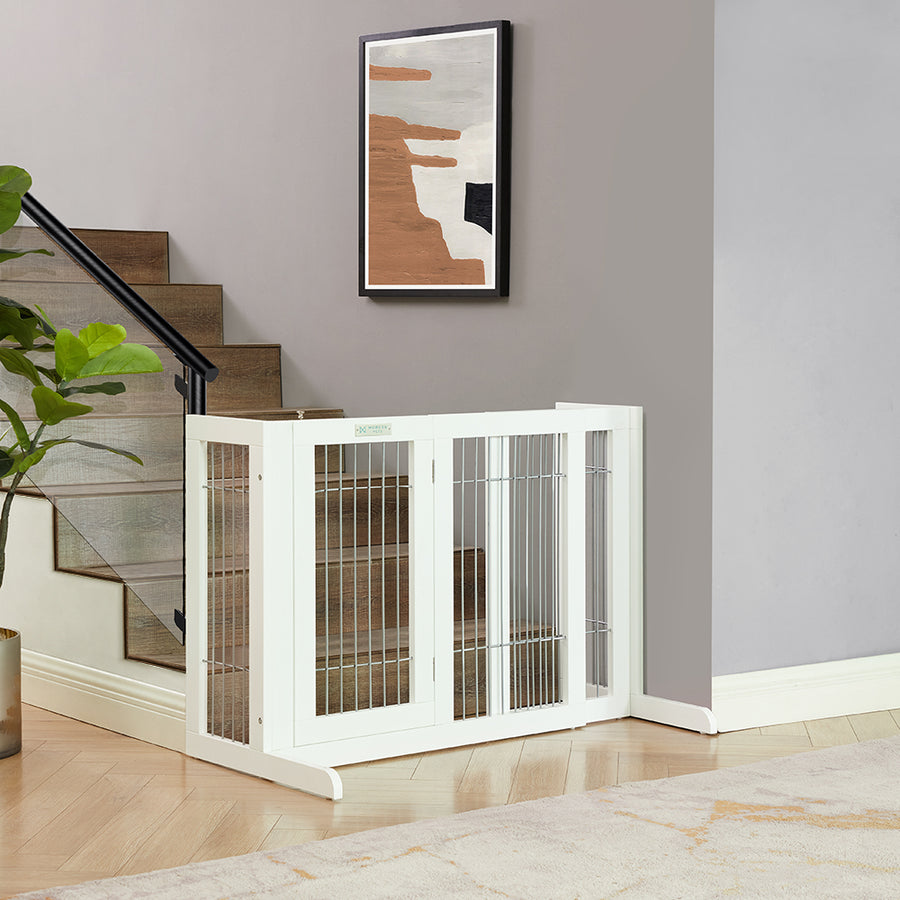
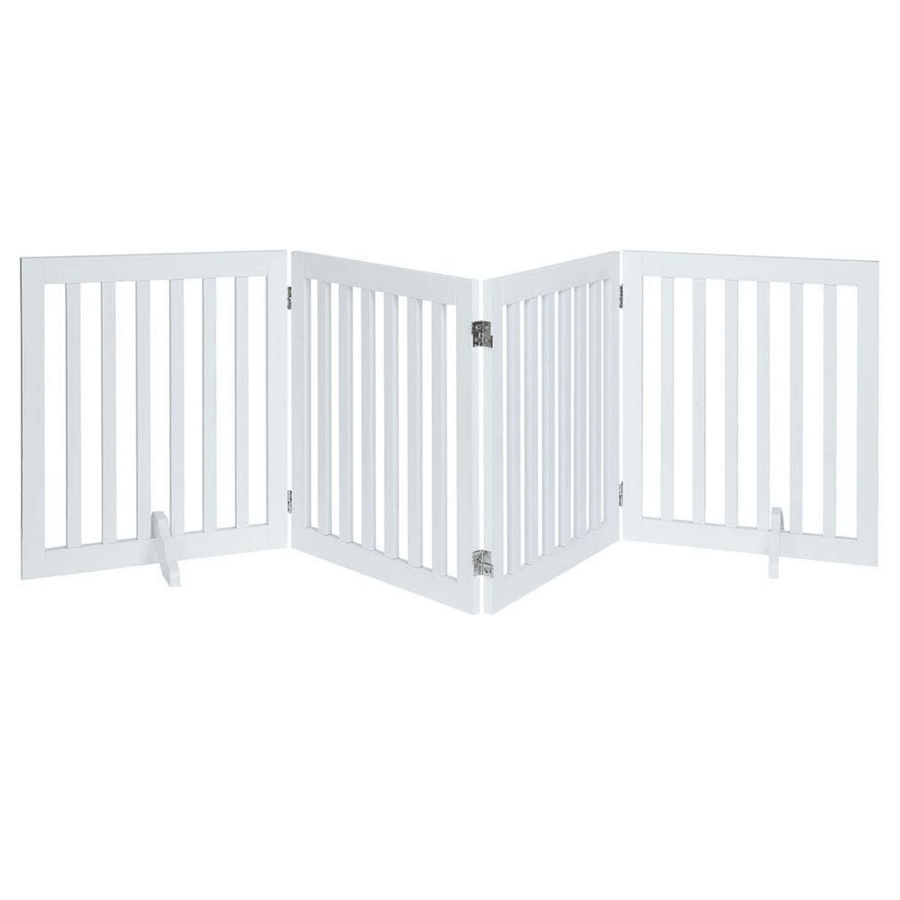
A wooden pet gate or wooden dog gate provides the same barrier function as a metal or plastic gate with a warmer, more furniture-like aesthetic that suits timber floors, natural interiors, and open-plan living spaces. Wooden dog gates for inside are a popular choice for owners who want effective containment without an industrial-looking barrier in their living area.
Things to check when choosing a wooden dog gate:
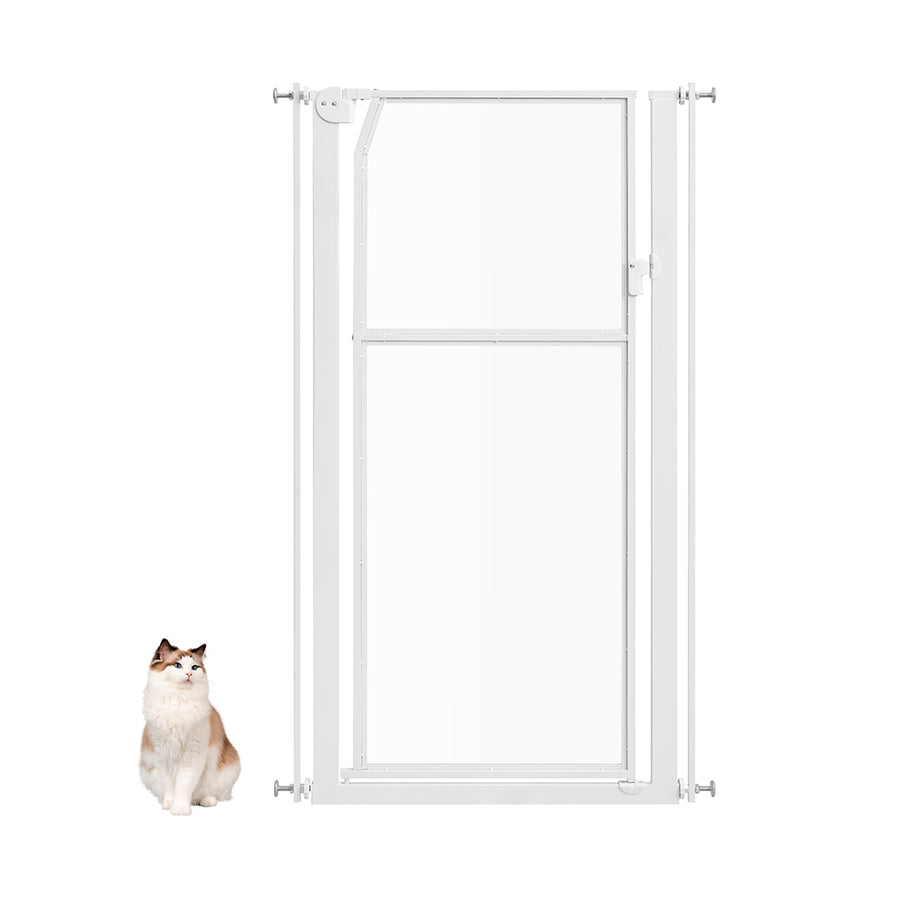
Some indoor dog gate designs incorporate a small built-in door or flap that allows a cat or small dog to pass through freely while keeping a larger dog contained. These are particularly useful in multi-pet households where cats or small dogs need access to areas that a larger dog should be excluded from, such as a cat's feeding area or litter box location.
Width and height are both critical measurements. For width, measure the narrowest point of the opening at both the floor and at gate height (doorframes and hallways are not always perfectly parallel). Most gates adjust within a range (e.g. 75–105cm); confirm your opening width falls within the gate's adjustment range.
For extensions beyond a gate's standard width, extension panels are available for most models. Check compatibility before purchasing.
Gate height is determined by your dog's size and jumping ability:
When in doubt, size up. A gate that is too tall is inconvenient for humans to step over; a gate that is too short will be jumped within days.
The latch is the most-used component of any dog gate. It needs to be operable by an adult with one hand (often while carrying something), secure enough that the dog cannot nose or paw it open, and child-safe if young children are in the household.
Common latch types:
For households with both children and dogs, a double-action child-safe latch is the recommended minimum.
A dog gate for stairs used at the top of the staircase must be wall-mounted, never pressure-mounted. A pressure-mounted gate at the top of stairs can be dislodged by a dog pushing against it, resulting in a fall that can cause serious injury.
At the bottom of stairs, a pressure-mounted pet safety gate is acceptable, as a dislodged gate at floor level does not create a fall risk.
For stair use, additionally confirm:
Standard doorway gates do not work in open-plan spaces with no walls to mount between. Options for open-plan areas include:
The standard indoor pet gate format (pressure-mounted or wall-mounted, with a walk-through door) suits most standard Australian doorways (typically 820mm wide). Confirm your doorway measurement before purchasing and check the gate's adjustment range.
For renters, pressure-mounted dog gates are the primary option for walls and doorways. For stair-top safety, some manufacturers offer no-drill wall-mounted kits that use adhesive anchor plates rated for gate loads. Confirm the load rating before use on a stair-top installation.
Baby gates and dog gates are often interchangeable for small dogs and puppies. However, there are important differences for medium and large dogs:
For small dogs and puppies in standard doorways, a quality baby gate used for dogs is a perfectly valid and often more affordable option. For large dogs, tall dogs, or situations requiring specific pet features, a purpose-designed pet gate is more appropriate.
Note:Safety guidance on gate mounting and stair use is provided for general information. Always follow the manufacturer's installation instructions and confirm that fixings are appropriate for your specific wall type before installing any wall-mounted gate.
Measure the width of your opening at its narrowest point, and check your measurement against the gate's adjustment range. For height, measure your dog from the floor to the top of their back and add at least 20–30cm, or more for dogs known to jump. For stair openings, measure width at both the top and bottom of the opening, as stair structures are often irregular.
A pressure-mounted pet gate uses rubber feet or tension to wedge between walls, no fixings required, easy to move, suitable for doorways and flat-bottomed stair gates. A wall-mounted dog gate is fixed to the wall with screws and brackets (more secure, required for stair-top use, and better suited to large or determined dogs). Never use a pressure-mounted gate at the top of a staircase.
A quality wooden pet gate or wooden dog gate made from hardwood or MDF with proper fixings is structurally strong enough for most small to medium dogs. For large breeds or dogs that push hard against barriers, a metal frame gate is generally more resistant to force and flex. Wooden gates excel where aesthetics matter; they suit timber-floored homes and open-plan interiors in a way that metal gates often do not.
Standard doorway gates require two surfaces to mount or press between, so they do not work in open-plan areas. Freestanding dog barriers or configurable pet fence panels are the practical solution for open-plan living areas. They can be arranged to span any gap and do not require wall fixings.
Choose a gate that is at least 20–30cm taller than your dog's back height. For known jumpers, a tall indoor dog gate of 90–100cm or more is appropriate. Consistency also matters. If a dog successfully jumps a gate once, the behaviour reinforces itself. A gate height that prevents the first jump is more effective than one that allows occasional success.
Most dog gates contain cats as effectively as dogs, but a cat determined to cross a gate will generally find a way over given their jumping ability. If your goal is to contain a dog while allowing a cat free access, look for a dog barrier gate with a built-in small pet door that the cat can pass through but the dog cannot.
Free metro shipping applies to orders over $99. Some larger or heavier gate models may attract oversized delivery conditions depending on your postcode. Check the individual product page or contact our team on 1300 268 060 or at customercare@modernpet.com.au to confirm shipping eligibility for your area.
© Modern Pets All Rights Reserved | Terms of Use | Privacy Policy